
1) Kick-off Meeting – Online
M.I.L.E. Project Successfully Launched with Global Online Kick-off Meeting
February 2025


The M.I.L.E. (Measuring Impact of Long and medium term Engagement) project was officially launched with a successful online Kick-off Meeting.
The event brought together key stakeholders from around the world to initiate the project and ensure a shared understanding of its goals, activities, and participatory approach.
The main objective of the meeting was to provide clear and updated information about the project’s workflow and to ensure all partners were aligned on the aims and expected outcomes.
A key focus of the discussion was the practical application of resources from the “Decolonise IVS” project. Participants reviewed Decolonisation Guidelines, Self-Assessment Tools, and educational materials, discussing how these could be integrated into the project’s research phase. The meeting also served to introduce the impact measurement tools that will be updated and used to assess LMTV programmes.
The event saw active participation from a diverse group, including the CCIVS Director, the project’s Impact Measurement Expert, Francesco Volpini, members of the CCIVS Youth Committee, and representatives from partner networks such as SCI, Alliance, ICYE, and NVDA. This collaborative start ensures that networks are committed to contributing to the project’s goals.
The Kick-off Meeting laid a strong foundation for this next phase, ensuring that the project is well-prepared to develop effective tools and gather meaningful data on the impact of long-term volunteering.
2) MILE – Measuring Impact in Long-term Exchanges: Training in Germany Builds Tools for Decolonised Research

From 8–12 April 2025, young volunteers and activists from across four continents gathered near Bonn, Germany, for the MILE Training on Impact Measurement and Decolonisation Tools, hosted by SCI Germany and coordinated by CCIVS and co-financed by the European Youth Foundation of the Council of Europe.
This international training brought together 15 participants and 4 facilitators to explore one of the core challenges of the International Voluntary Service (IVS) movement: how do we know our projects make a difference—and whose perspective is shaping the answer?
The MILE training took that question seriously, focusing on two key pillars: social research and decolonisation.
Over five intensive days, the group navigated key concepts in participatory evaluation, qualitative research, and justice-centered approaches. They learned how to design and conduct interviews, develop meaningful indicators, and apply a decolonial lens to long- and mid-term volunteer projects (LMTV).


Learning in Practice
Sessions combined self-reflection, role-plays, peer interviews, group work, and a hands-on approach to social research. Participants created their own interview tools, practiced conducting them, and received detailed guidance on analysing and presenting data. The final day was devoted to preparing for the next phase of the project: field research in their own LMTV contexts.
While the original plan included an external site visit, the team pivoted smoothly to simulate interviews onsite—an adjustment that was met with enthusiasm and allowed participants to test multiple roles as researchers and interviewees.
A Space for Global Reflection
Beyond research skills, the training offered a rare and necessary space to reflect on power, knowledge, and perspective in global volunteering. Participants explored what decolonisation means in their work, questioned inherited narratives, and drew connections between social justice and IVS practice.
This work was grounded in tools developed through past CCIVS initiatives and enriched by the diverse backgrounds of the participants, who came from Asia, Africa, the Americas, and Europe.

Laying Foundations for Change
The MILE training marked a key turning point in the project’s timeline. It followed the online kick-off meeting and laid the groundwork for participants to conduct interviews in the coming months. These interviews will later inform a collective impact analysis and help shape future advocacy, promoting the impact of Long Term volunteering on volunteers and on the communities where they work.
A number of participants even volunteered to continue supporting the research coordination, offering time to assist with data analysis and content development—clear proof of the motivation and commitment within the group.
Next Steps
In the months ahead, participants will carry out their field research, using the tools and methods developed during the training. Their findings will feed into the broader MILE work plan and contribute to building more inclusive, evidence-based, and decolonised IVS practices across the network.
For more updates, stay tuned to ccivs.org and follow us on social media.
3) Impact Measurement in Action (May–October 2025)
After the training in Germany, participants returned to their organisations and countries and conducted the interviews in the local LMTV projects.
The research covered three groups: long and medium-term volunteers, members of the hosting organisations, and members of the local communities.
Working from the guidelines
Each researcher used the interview guidelines co-designed during the training, which had a separate version for each of the three groups. Researchers were asked to conduct at least three interviews: one with a current volunteer, one with a member of the coordinating organisation, and one with a member of the local community. The interviews were semi-structured and qualitative, lasting between 30 and 60 minutes. They were recorded with the participant’s consent, transcribed, translated into English where the interview was held in another language, and anonymised. Researchers also noted non-verbal cues such as pauses and laughter in the transcripts.
A decolonising perspective in the analysis
A key point from the training was that a decolonising perspective applies during analysis as well as in the questions. When reading back through the transcripts, researchers gave attention to what was said, what remained unsaid, and how impact itself was being defined.
What the fieldwork produced
The network completed 54 interviews across 15 partner organisations, in 16 countries and 14 languages, and transcribed almost 600 pages of discussion. Some of the researchers also took part in the analysis, using a shared grid to classify observations by theme and helping to draft preliminary conclusions.
Interviews and transcribed pages by participating organisation:
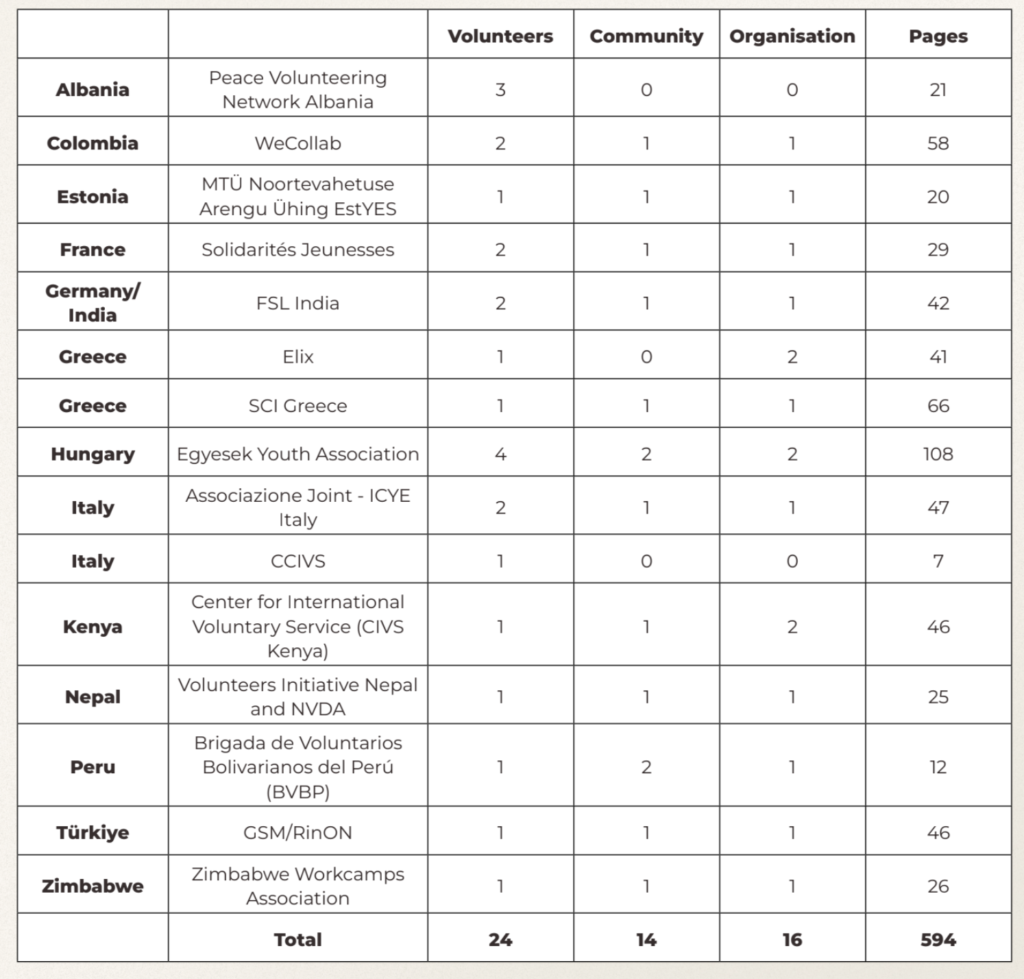
This fieldwork is the evidence base presented in the project’s final report, Walking the M.I.L.E.
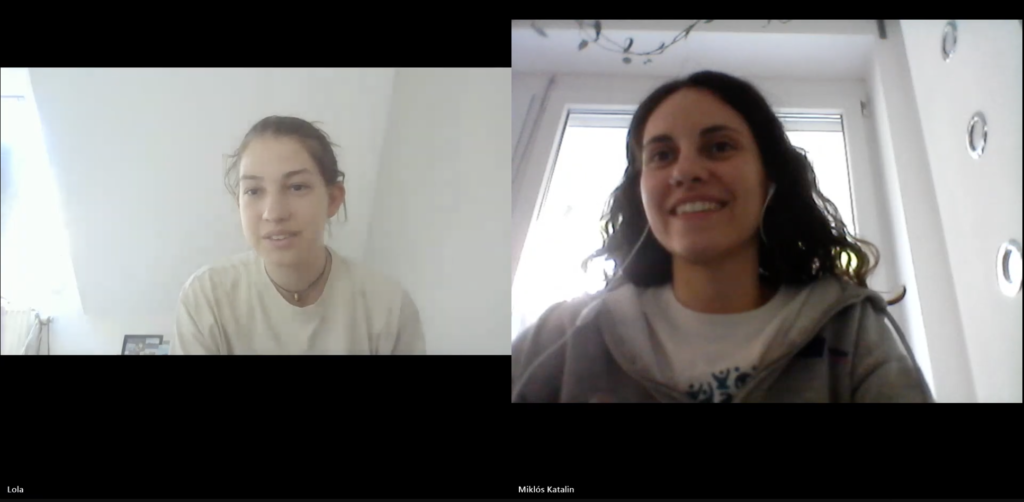
Miklos Katalin from Egyesek conducting an interview to a former Long Term Volunteer.
4) Presentation & Online Conference (November–December 2025)
In the final stage of the project, the preliminary findings were shared through CCIVS spaces and a wider dissemination moment in an online conference format, building dialogue with partners and policy stakeholders.
Walking the M.I.L.E.
The findings are gathered in the project’s final report, Walking the M.I.L.E.: Voices from volunteers, communities and organisations. The report presents the findings across the three stakeholder groups, together with the cross-cutting themes and the strategic recommendations that came out of them, organised around four levers: preparation, care, inclusion and funding. Read the report.
Watch the final conference
A recording of the conference is available below.