
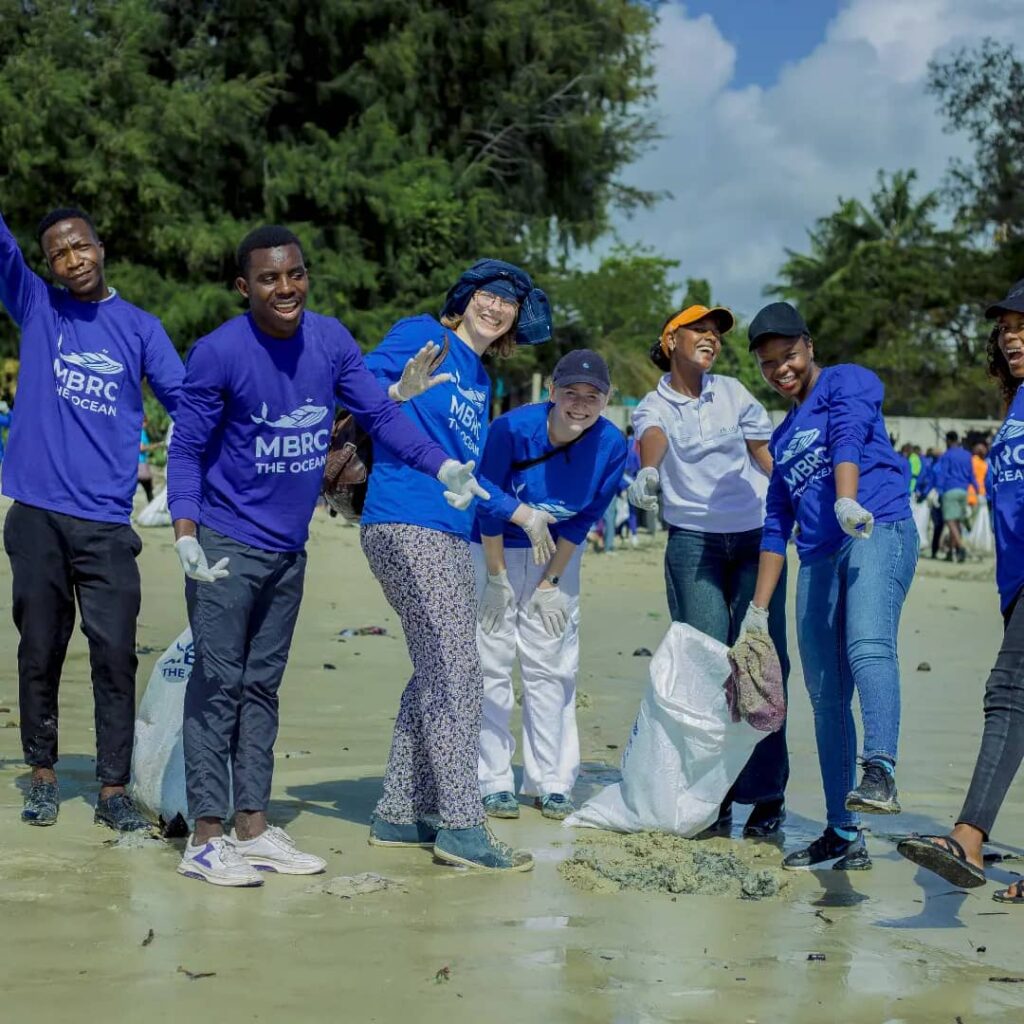
From May 2025 to January 2026, the Youth-Led Climate Action and Ecosystem Restoration Program mobilized young people, students, community members, people with special needs, civil society organizations, and local authorities across Dar es Salaam and Dodoma, Tanzania.
Working in coastal beaches, flood-prone neighborhoods, university campuses, and public spaces, the program combined practical climate action with inclusive environmental education. It addressed marine plastic pollution, poor waste management, urban heat, and climate vulnerability while strengthening youth leadership, social inclusion, and community ownership of environmental stewardship.
Addressing Marine and Community Waste
In Dar es Salaam, monthly beach clean-ups were conducted across six beaches, including Aga Khan Beach and Maga Beach, in collaboration with MBRC The Ocean and local partners.
Community clean-ups were also organized in flood-prone and high-waste areas near residential neighborhoods and marketplaces. Youth volunteers, students, and institutions such as Kinondoni Municipal Council, AHRN Foundation, CAN Tanzania, Tanzania Youth Biodiversity Network (TYBN), Green Science Organization, and local leaders worked together to collect and categorize waste.
The waste included plastic bottles, sachets, food packaging, discarded clothing, and electronic waste. Each clean-up was followed by short awareness discussions on waste sources, flooding, public health risks, and marine ecosystem impacts.
Through repeated action, participants recognized that marine plastic pollution is a systemic issue requiring cooperation between communities, institutions, and young people.
“Cleaning multiple beaches made it clear that marine plastic pollution is a systemic issue that requires cooperation between communities, institutions and young people.”
Philipo M. Kisizi, Environmental Consultant & Climate Activist, Tanzania
Youth-Led and Inclusive Tree Planting for Climate Resilience
Beyond clean-ups, the program focused on increasing urban tree cover and strengthening climate resilience.
“LIVE-EX helps me learn that tree planting is not just about putting seedlings in the ground, it is about planting responsibility and hope for future generations.”
Thomas Greenwell Sichimba, Project Coordinator – Tanzania
Greening the University of Dar es Salaam
In May 2025, youth participated in a tree-planting activity organized by the Rotaract Club of Dar es Salaam in partnership with TYBN. Seedlings were planted using proper techniques, alongside discussions on biodiversity conservation, carbon sequestration, and improving the campus microclimate.
The activity connected climate knowledge with visible, practical action.
Inclusive Tree Planting with People with Special Needs
An inclusive tree-planting activity in Dar es Salaam, organized in partnership with Mazingira Plus, actively engaged people with special needs, including participants who are unable to speak.
A total of 200 indigenous and climate-resilient tree seedlings were planted. Accessible and participatory methods ensured meaningful involvement for all participants. The initiative promoted dignity, visibility, and equal participation in environmental action.
Greening Dodoma City
Between December 2025 and January 2026, over 100 indigenous and drought-tolerant trees were planted in public spaces in Dodoma, including schools and community areas.
Given Dodoma’s semi-arid climate, the program emphasized tree-care practices such as mulching, structured watering schedules, and shared monitoring by student groups, environmental clubs, nearby residents, and caregivers to improve survival rates.
What Changed?
The program contributed to a clear shift from discussion to practical engagement.
Youth, students, and community members developed a stronger understanding of how waste management, tree cover, and daily behaviors influence climate resilience, marine health, flooding, and urban heat.
The inclusive tree-planting initiative demonstrated that people with special needs can actively contribute to climate action when programs are intentionally designed to be accessible and respectful.
Participants gained confidence to act as environmental ambassadors within schools, universities, and local communities. Collaboration between youth groups, civil society organizations, and local authorities strengthened ownership and long-term environmental impact.
“LIVE-EX showed me that young people can be powerful agents of change when given the right knowledge and opportunity.”
Farida Saidi, Environmental Advocate, Tanzania
Challenges and Adaptations
Waste quickly re-accumulated in coastal and community areas. To address this, clean-ups were combined with targeted awareness efforts on waste reduction at source and institutional responsibility.
Initial participation was low in some communities. Engagement improved through collaboration with local leaders and peer-to-peer youth mobilization.
Tree survival posed challenges, especially in urban and semi-arid environments. The program responded by selecting drought-tolerant species, planting during rainy periods, and promoting shared responsibility for tree care.
Read more about Live-EX project HERE.