
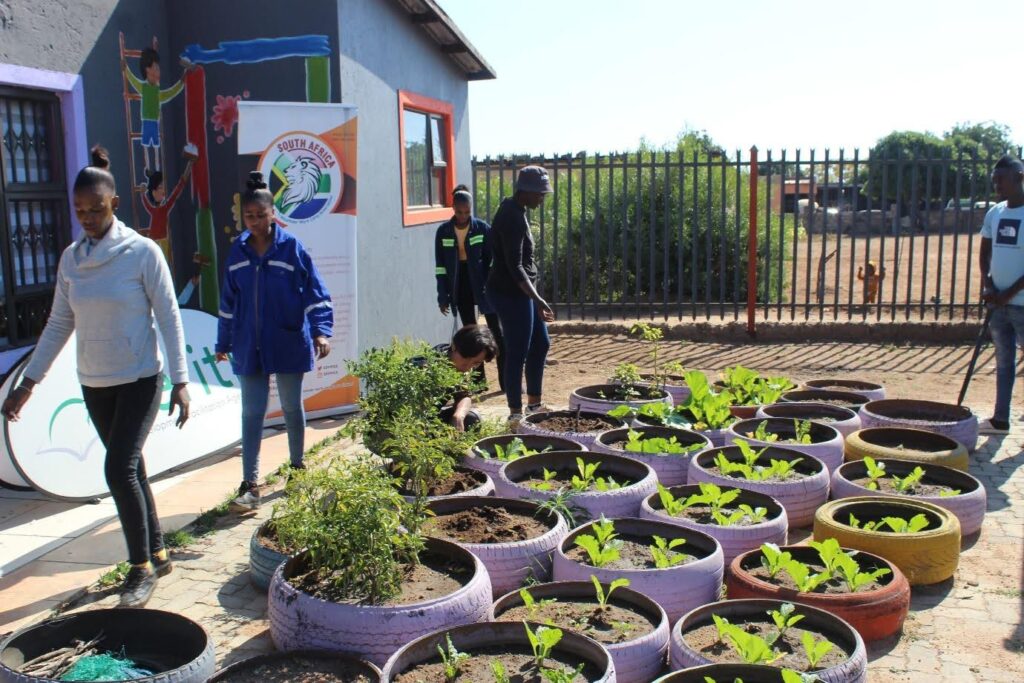
In Soshanguve and Mabopane, a group of 15 active SAVWA youth volunteers partnered with Early Childhood Development (ECD) centres to address food insecurity through a practical and sustainable solution: no-dig gardening.
The project focused on building community food gardens at ECD centres to provide fresh, nutritious vegetables for children while strengthening collaboration between youth, teachers, and parents.
Why This Project Matters
Many children attending local ECD centres come from households facing food insecurity. ECD centres often struggle to provide consistent, nutritious meals. At the same time, young people in the community are eager to contribute to positive change.
The Growing Futures initiative responded to both challenges by creating sustainable food gardens directly within ECD centres. The gardens serve as a source of healthy produce and as a learning platform for environmental awareness and community cooperation.
Learning a New Way to Garden
Before joining LIVE-EX, many participants viewed gardening as a simple process of digging, planting, and harvesting.
Through mentorship and training, the group was introduced to no-dig gardening, a method that avoids traditional soil digging and instead builds layered garden beds using recyclable materials such as cardboard boxes to suppress weeds naturally.
This technique demonstrated that gardening does not need to be resource-intensive or physically demanding. It can be practical, accessible, and adaptable to small spaces.
Participants learned:
- How to build garden beds without digging
- How to use recyclable materials for weed prevention
- How to maximize small spaces for food production
- How to allow natural processes to improve soil health
The approach inspired many volunteers to start gardens in their own homes, increasing access to fresh and organic vegetables.
Beyond food production, the project also introduced entrepreneurial thinking. Participants explored how surplus vegetables could generate income, strengthening both food security and economic resilience.
“Before joining LIVE-EX, I thought gardening was simply digging and planting. Through mentorship, I learned no-dig gardening and realised that gardening doesn’t have to be complicated. A home garden can provide fresh, organic food for a family and also create an opportunity to earn income by selling vegetables.”
— Munaka Mphagi, Mentee, South Africa
Challenges and Adaptation
The project faced several challenges:
- Harsh climate and weather conditions
- Insect and pest management
- Limited space in some centres
- Lack of proper fencing to protect gardens
These challenges required adaptation, including improved pest management strategies, creative use of small spaces, and stronger community involvement to protect and maintain garden areas.
Despite obstacles, the volunteers’ commitment and willingness to act remained strong.
Youth Growing More Than Vegetables
The Growing Futures project demonstrates that youth-led environmental initiatives can simultaneously address food security, climate awareness, and economic opportunity.
By combining no-dig gardening techniques with community collaboration, SAVWA youth volunteers are not only growing vegetables—they are cultivating resilience, skills, and long-term community impact.
Practical, local action continues to prove that climate solutions do not always require large-scale infrastructure. Sometimes, they begin with cardboard, compost, and committed young people.
“Before joining LIVE-EX, I had little understanding of climate change. Through the programme, I learned that climate justice already exists in our communities. My team and I created a way to reduce waste by turning recyclable materials into toys for local kindergartens, while also teaching community members how to make and sell toys from waste. One person’s trash truly is another’s treasure.”
— Banele Zwane, Mentee, South Africa
Read more about Live-EX project HERE.