


About | Activities | News | Advocacy and Policy | Resources | Change Capsule | Contact
The Sound of Change
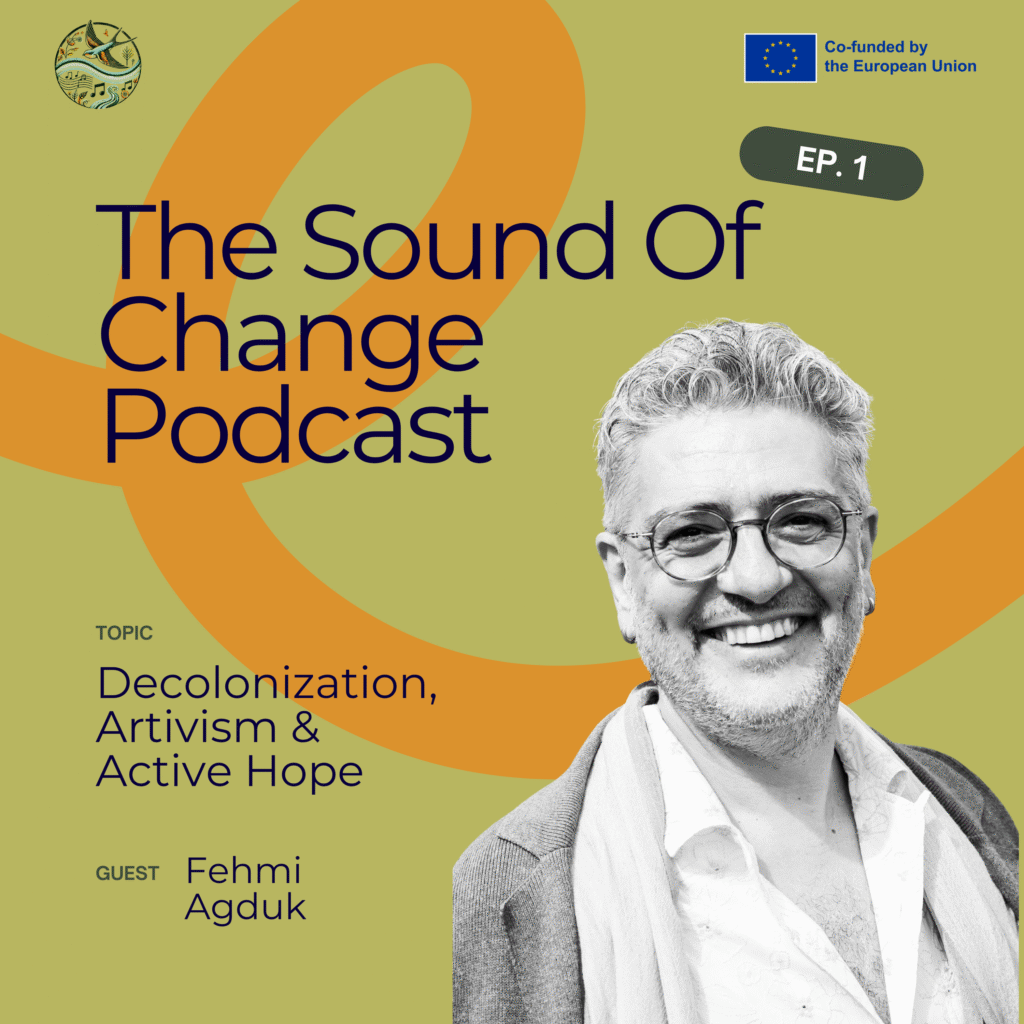
Episode 1: Act Now
Listen it now!
In the first episode of The Sound of Change, we sit down with Sait Fehmi Agduk, a communication and advocacy expert from Turkey with nearly 20 years of experience working with rights-based NGOs.
Fehmi joins us at the Earth Artivists Training in Nairobi, Kenya, where participants from across Africa, Asia, Europe, and Latin America gathered to explore the intersection of music, voluntary service, and social change. Interviewed by Raksha Shenoy (FSL India) and Ian Mugowa (Zimbabwe Workcamps Organisation), Fehmi takes us through a rich conversation about what change really means, why decolonization is not just a political concept but a question of mindset, and why active hope — not passive waiting — is the most urgent call of our time. He shares a striking story from his work in an African country, where water department officials asked whether they were “allowed” to use their own methods in their own country — a moment that reveals how deeply colonial patterns can shape the way people think about their own authority and agency.
Fehmi also reflects on the power of artivism — the fusion of art and activism — and why music, more than almost any other medium, has the ability to reach people across languages, cultures, and borders. After days of face-to-face exchange with participants from different continents, he speaks to the irreplaceable value of human connection in a world that moved so much of its learning Online.
Colonizing the minds, colonizing the mindset — that’s the major issue.
If we cannot free our minds from that mentality,
we will always be told what we are going to do.
His message to close the episode is simple and direct: Act now.
The Sound of Change is produced as part of Voices for Change, a project coordinated by the Coordinating Committee
for International Voluntary Service (CCIVS) and co-funded by the European Union under the Erasmus+ programme.
Co-funded by the European Union. Views and opinions expressed are however those of the author(s) only and do not necessarily reflect those of the European Union. Neither the European Union nor the granting authority can be held responsible for them.
